Oct 27, 2026
Articles
Articles / Oct 14, 2026
Is African energy investment a choice between solar and oil?
When it comes to solar and oil, African energy is a story of ‘both’ ‘and’. MISA Group CEO Guy Hacking unpacks the balance needed in your investment philosophy.

Guy Hacking
MISA Group CEO · 5 Minutes
When it comes solar and oil, Africa is buying both. Solar panel imports reached 23GW in the 12 months to June 2026, up 53% (Ember), yet Ember’s 2025 analysis found refined fuel imports were worth 30-107x solar imports in nine of the 10 largest solar markets. The right mix is local: resources, grid, demand profile and delivered cost per kilowatt hour.
How fast is solar energy growing in Africa?
According to Dave Jones, Chief Analyst at Ember, Africa imported 15GW of solar panels in the 12 months to June 2025, up 60% on the year before. Outside South Africa, imports nearly tripled in two years, from 3.7GW to 11.2GW.
The pace has held. Ember’s 2026 analysis counts 23GW of panels imported in the 12 months to June 2026, up 53% year on year, and expects Africa to install a record 17GW of solar in 2026. Ember estimates that three-quarters of the growth is distributed solar.
Why does Africa still spend more on fuel than on solar?
Another number is also true. In nine of the 10 largest solar importers, the value of refined petroleum imports is 30-107x the value of solar panel imports (Ember). Africa is not choosing. Africa is buying both, and it is spending vastly more on the fuel.
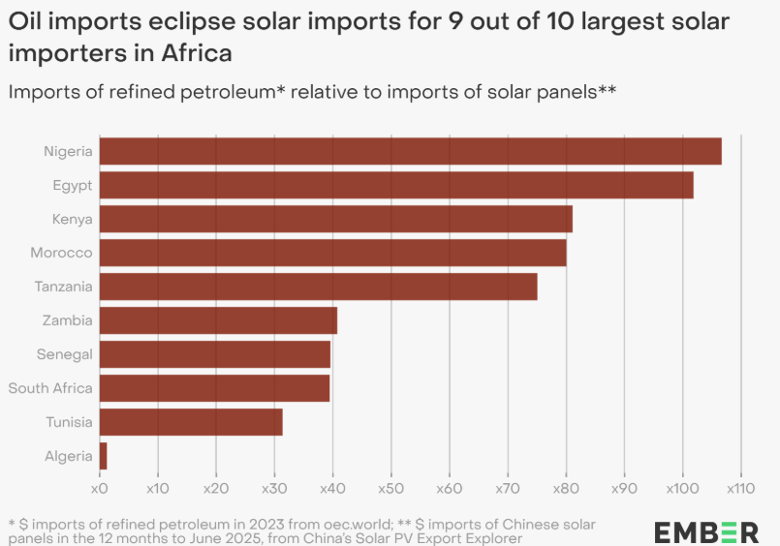
Image caption: Oil imports eclipse solar imports for nine of the ten largest solar importers in Africa. Refined petroleum imports in 2023 (oec.world) relative to Chinese solar panel imports in the 12 months to June 2025. Chart: Ember, “The first evidence of a take-off in solar in Africa”, 26 Aug 2025, CC BY 4.0.
What does this mean for West African fuel supply?
Nigeria sits at the top of Ember’s chart, and Senegal is in the top 10. Generators, transport and industry across West Africa run on imported refined products, and that demand does not disappear while solar scales. Fuel has to keep flowing.
The economics are also pulling hard the other way. Ember calculates that in Nigeria a 420W panel retailing at US$60 pays back the imported diesel it replaces in about six months, at a diesel price of US$0.66 per litre. Across the continent, Ember’s 2026 analysis finds that running a diesel generator costs as much in fuel every three months as a solar panel producing the same electricity.
“This tension is why MISA Group has taken the investment position it has. We don’t have a renewables-versus-hydrocarbons philosophy. We hold deep positions in both.”
Guy Hacking
MISA Group CEO
How should investors choose the energy mix for African energy investment?
This tension is why MISA Group has taken the investment position it has. We don’t have a renewables-versus-hydrocarbons philosophy. We hold deep positions in both. What decides the mix is local and unglamorous: what resources you have, what your grid can carry, what the demand curve looks like through the day, and what a kilowatt hour costs you, delivered.
In some places the answer is gas or diesel. In many others, it is solar and wind with storage. In most it is a combination, and that combination shifts every few years as the cost of solar and storage keeps falling while fuel prices stay volatile.
Is renewable energy in Africa bankable?
My own view is that for most of Africa, the right mix ends up with a far higher share of renewables than today. Not for climate reasons, but because it is cheaper, and because a solar panel doesn’t send you a foreign currency invoice every month.
The resource is there. Africa is home to 60% of the best solar resources in the world, yet only 1% of installed solar PV capacity (IEA Africa Energy Outlook 2022). The demand is there too: the IEA counts 600 million Africans, 43% of the population, without electricity. The World Bank and African Development Bank’s Mission 300 aims to connect 300 million people by 2030, and reports more than 50 million connected across 40 countries so far.
How is MISA Group invested across African energy?
At MISA Group, we understand the importance of a diverse portfolio of energy sources for a complex, evolving and fast-growing continent. It’s why we are invested across the energy value chain (see our portfolio):
- Mocoh: trading and supplying essential fuels across Africa (mocoh.com)
- MISA FZC: global base oils trading
- MISA Energy: fuels, lubricants and commercial energy solutions in Ghana (misaenergy.com)
- Bioscape: waste-based feedstocks for renewable fuels in Nigeria (bioscapeafrica.com)
- Modaso: hybrid solar, wind and battery projects at scale (modasoenergy.com)
Guy Hacking is Chief Executive Officer of MISA Group. Guy began his career in private equity and investment banking, acquiring and operating infrastructure assets. He joined Mocoh to support its asset investments before becoming CFO and then CEO. Today he leads MISA Group’s strategy and capital allocation, building institutional-grade businesses that pair commercial returns with lasting impact across Africa’s energy landscape.
Related reading
Frequently asked questions about African energy investment
- Is Africa moving away from oil and gas?
Not yet. Solar is growing fast: Ember counts 23GW of solar panel imports into Africa in the 12 months to June 2026, up 53%. But Ember’s 2025 analysis found that in nine of the 10 largest solar importers, refined petroleum imports were worth 30-107x more than solar imports. Africa is adding solar alongside fuel demand, not replacing it, and both markets need investment.
- Why is solar growing so quickly in Africa?
Cost. Ember estimates that a 420W panel bought for US$60 in Nigeria pays back its diesel cost in about six months. Across the continent, running a diesel generator costs as much in fuel every three months as a solar panel producing the same electricity. Panels also cut exposure to imported fuel priced in foreign currency, a recurring cost for businesses and households.
- Is renewable energy in Africa bankable?
It can be, when projects match real demand and creditworthy customers. Africa holds 60% of the world’s best solar resources but only 1% of installed solar PV capacity, according to the IEA. MISA Group’s view is that bankable projects depend on who buys the power, in what currency and how reliably they pay, and that the energy mix should be set market by market.
- How does MISA Group invest in African energy?
MISA Group is an Africa-focused energy investment group built on three decades of trading hydrocarbons. It invests in and operates businesses across the energy value chain: fuel trading and supply (Mocoh), base oils (MISA FZC), fuel distribution in Ghana (MISA Energy), waste-based renewable fuels in Nigeria (Bioscape) and hybrid solar, wind and battery projects (Modaso).
Posted in Articles