Oct 20, 2026
Articles
Articles / Oct 27, 2026
Why does population density matter for African energy investment?
Density sets the cost of every connection, and in parts of Africa the arithmetic has turned.

Guy Hacking
MISA Group CEO · 5 minutes
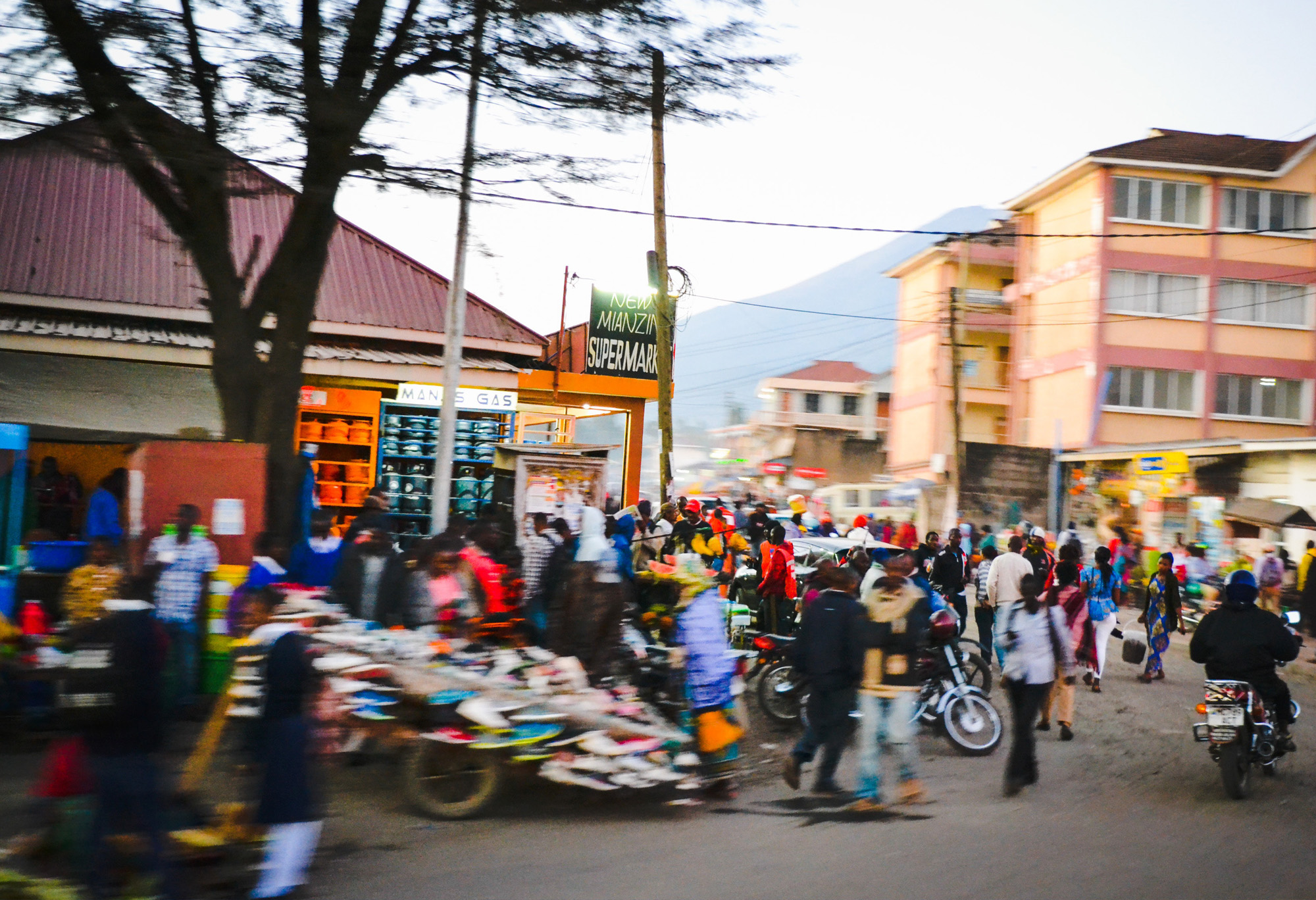
Does Africa have too few people for growth?
Africa’s population is roughly the same as India’s, spread across around nine times the land. The UN puts Africa at 1.51bn people in 2024 and India at 1.45bn (INED, using UN World Population Prospects 2024).
That is the starting point for a Financial Times piece by David Pilling asking whether Africa has too few people, which draws on Joe Studwell’s book, How Africa Works.
Studwell argues that low population density, more than politics or resources, has been the single biggest brake on African growth. Without enough people close together there are no agglomeration economies, and the roads, grids, schools and hospitals a state needs cost too much per person to build.
In 1960, he says, Africa’s population density was a fifth of Asia’s (Conversations with Tyler). By 2030 Africa will reach the density Asia had in 1960, the point at which Asia’s economies began to take off (Foreign Policy).
How does population density shape African energy investment?
About 600 million people in Africa live without electricity (IEA). Ask anyone in my industry why, and you will hear about tariffs, utility creditworthiness and politics.
All three matter. Studwell’s answer comes before all three. A thinly spread population leaves the cost per connection too high, whatever else you fix.
The cost data points the same way. In 2020, Brookings found that the rural electrification programmes it studied cost an average of more than US$1,500 per connection, and that national utility connection costs often exceed US$2,000 in rural areas (Brookings). The same analysis notes that the denser the population, the cheaper each connection, because distribution has economies of scale.
Fix the tariff and the utility’s balance sheet, and a line to a scattered rural settlement still costs more per customer than a line into a crowded city district. For investors, density is the first filter, not the last.
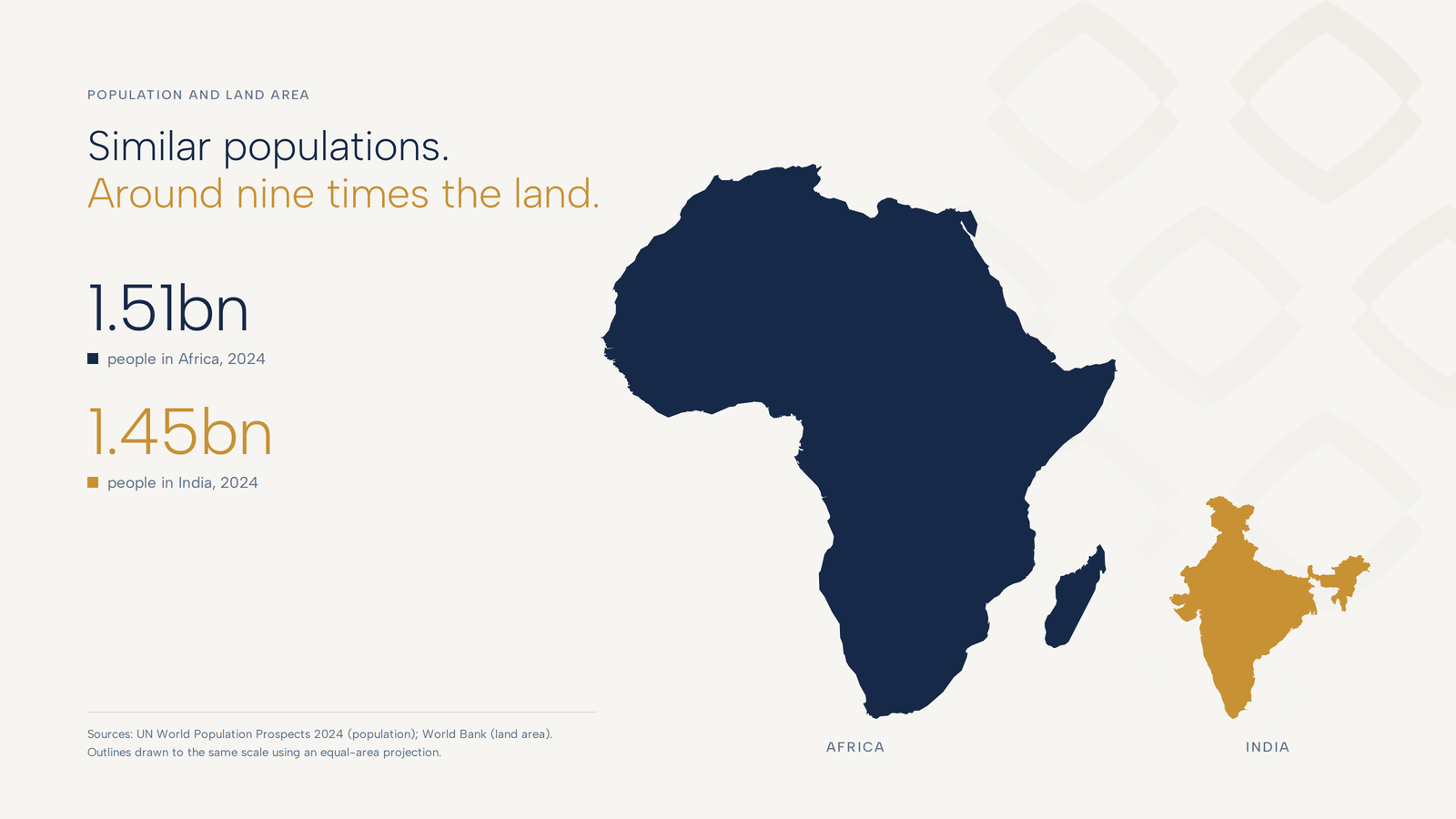 Africa and India have similar populations, but Africa has around nine times the land. Population: UN World Population Prospects 2024. Land area: World Bank. Outlines drawn to the same scale.
Why do some people reject the density argument?
The comments under the FT piece were almost more instructive than the article. Readers were angry at the suggestion that Africa needs more people, when in their experience it already cannot feed, water or employ the ones it has.
Both are right somewhere. Africa is 54 countries and thousands of local economies. In a dispersed rural district, more people can mean more pressure on land and water with no new market to show for it. In a fast-growing city corridor, the same growth can mean a customer base large enough to justify a grid, a factory or a fuel network.
Studwell accepts that density alone is not enough. He points to Nigeria’s Delta, more densely populated than most of Africa, which has struggled since independence (Conversations with Tyler).
Where is renewable energy in Africa bankable today?
In pockets, the conditions are now in place. Enough people live close enough together for a grid connection to pay, for a factory to have a local market, and for domestic demand rather than an export price to carry growth.
Africa now has 90 cities with populations above 1mn, against two in 1960 (FT review, via Joe Studwell). Each is a market where a power plant, a fuel depot or a mini-grid can reach thousands of paying customers within a few kilometres.
That is what compounds into a self-sustaining economy. Demand from customers nearby is steadier than demand set by a commodity price on the other side of the world, and it is the kind of demand a lender can underwrite.
Finding those pockets is done country by country, often city by city. Continental averages will not show you where they are.
Where does MISA Group fit in African energy investment?
MISA Group is built on three decades of trading hydrocarbons across Africa, so we see where demand concentrates before it shows up in the statistics.
Through Mocoh, MISA FZC and MISA Energy we keep oil, fuel and lubricants moving to the markets that need it today. Through Modaso we develop renewable, hybrid projects at scale, and through Bioscape we produce waste-based feedstocks for renewable fuels in Nigeria.
Our approach is to invest where the demand already exists, and to build the supply that lets it grow. You can read more on our Approach page, or see our portfolio.
Related reading
“Fix the tariff and the utility's balance sheet, and a line to a scattered rural settlement still costs more per customer than a line into a crowded city district. For investors, density is the first filter, not the last.”
Guy Hacking
MISA Group CEO
Frequently asked questions about population density and African energy investment
How does Africa’s population density compare with Asia’s?
Joe Studwell’s How Africa Works argues that Africa’s population density in 1960 was about a fifth of Asia’s, and that by 2030 Africa will reach the density Asia had in 1960, when its economies began to take off. Africa now has about 1.51bn people, close to India’s 1.45bn, across roughly nine times the land, according to UN World Population Prospects 2024 figures.
How many people in Africa lack electricity?
About 600 million people in Africa have no electricity, according to the International Energy Agency (IEA), and around 80% of everyone without access worldwide lives in sub-Saharan Africa. The IEA names insufficient capital as one of the biggest barriers. Low population density adds to the problem by raising the cost of each grid connection, which is why off-grid solar and mini-grids serve many rural areas.
Why does population density affect the cost of electricity access
Grids carry high fixed costs. A kilometre of distribution line costs broadly the same whether it serves ten homes or several hundred, so the cost per customer falls as density rises. Brookings found that the rural electrification programmes it studied averaged more than US$1,500 per connection (2020). In dense urban areas, the same investment reaches far more paying customers and pays back faster.
Is renewable energy in Africa bankable?
It can be, where demand is concentrated and customers can pay. Bankability depends on who buys the power, in what currency and how reliably they pay, and dense urban and industrial markets give lenders more paying customers per kilometre of grid. MISA Group’s view is that the best opportunities are found country by country, often city by city, rather than from continental averages. At MISA Group, we have world-class experts paired with 30 years’ experience operating in Africa to enable us to effectively assess opportunities and then take high-conviction positions in the right projects.
Guy Hacking is Chief Executive Officer of MISA Group. Guy began his career in private equity and investment banking, acquiring and operating infrastructure assets. He joined Mocoh to support its asset investments before becoming CFO and then CEO. Today he leads MISA Group’s strategy and capital allocation, building institutional-grade businesses that pair commercial returns with lasting impact across Africa’s energy landscape.
Posted in Articles