Nov 9, 2026
Articles
Articles / Nov 9, 2026
What makes a hybrid renewable energy project in Africa bankable?
Not the most megawatts: rather, a design tested against the hours the buyer will pay for.

Charles Haworth
Co-founder and COO/CTO, Modaso Energy, part of MISA Group · 7 minutes
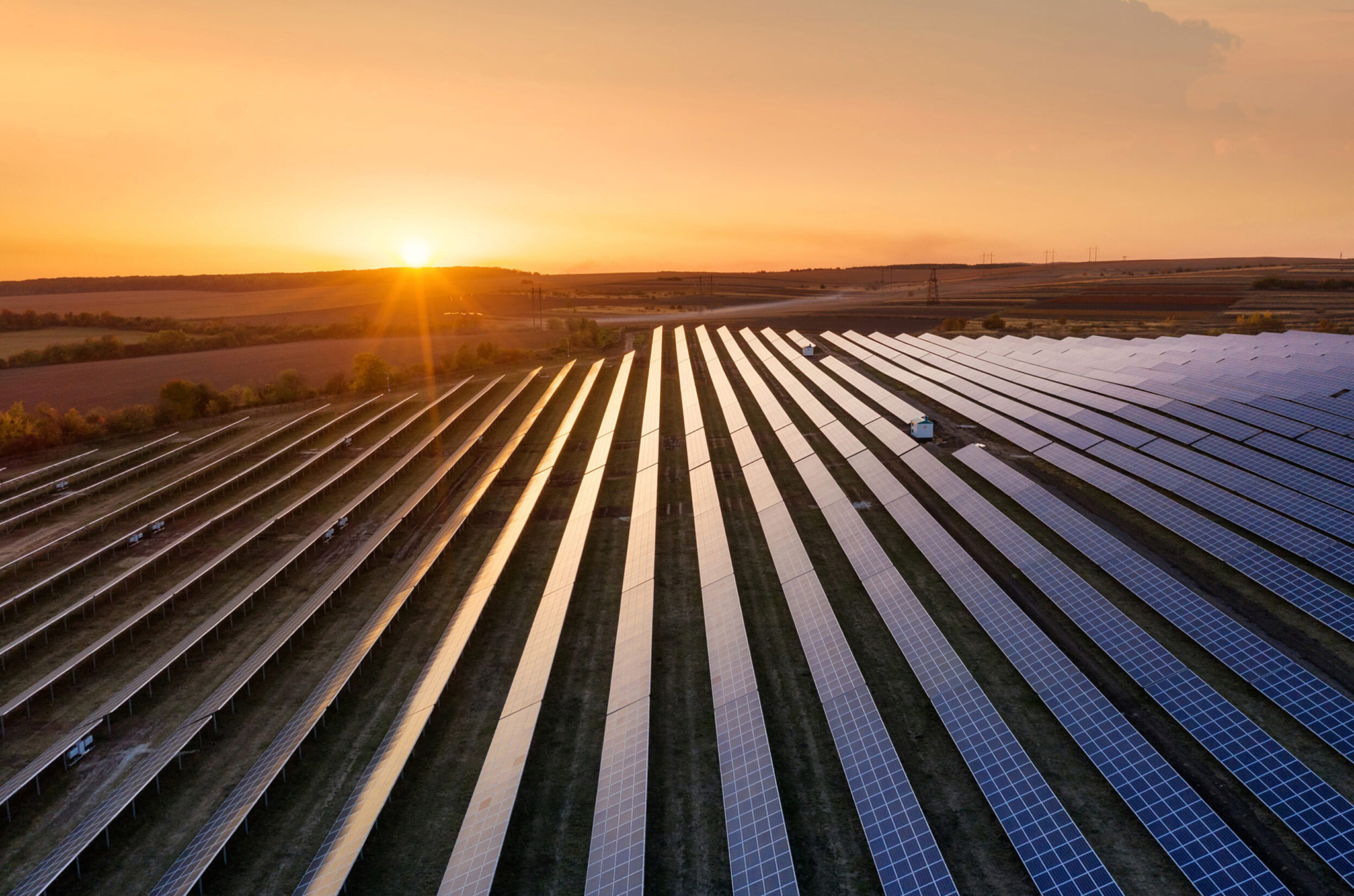
A hybrid renewable energy project in Africa is bankable when its design is tested against the hours its buyer values, not when it has the most megawatts. Investors should ask how wind, solar, storage and the grid connection perform together, hour by hour, against the offtake contract, and whether each component earns its place before capital is committed.
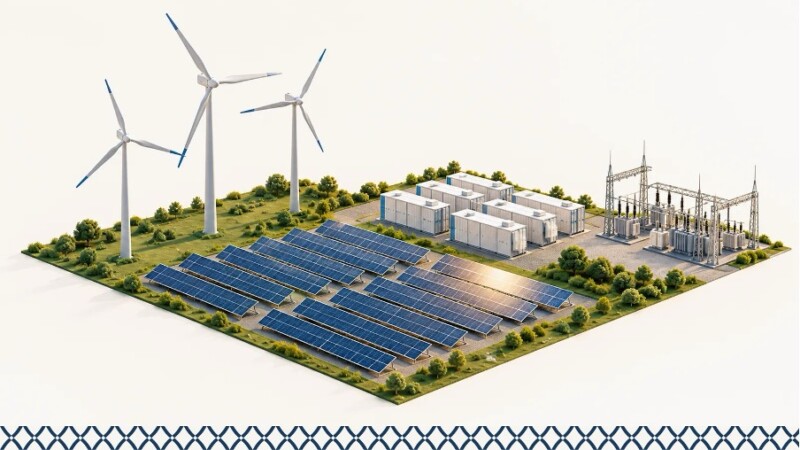
Illustration: a hybrid plant combines wind turbines, solar PV, battery storage and a substation that share one grid connection.
Renewable projects are usually described by their hardware: megawatts of wind and solar, megawatt-hours of storage, then an annual energy yield and a levelised cost of energy.
Those figures are necessary, but they do not answer the commercial question: does this project deliver power when the buyer values it? Given the intraday volatility, that is the question that all projects should answer first; yet it is only the hybrid ones that can. In Africa, the answer often decides whether a project reaches financial close at all.
The resource is not the constraint. Africa is home to 60% of the world’s best solar resources (IEA, 2022), yet it added only 11.3GW of the 693GW of renewable capacity installed worldwide in 2025, about 1.6% (IRENA, 2026). Wind is strong in many of the same markets. What is scarce is projects that a buyer wants and a lender will finance; that starts with design.
Why does an annual average hide the value of a hybrid project?
A hybrid project earns revenue in particular hours, not in an annual average. The value of each megawatt-hour changes with the offtake contract, the limits of the grid connection, and the buyer’s delivery requirement.
An annual model cannot show whether solar arrives in a valuable window, whether wind fills the gaps around it, or whether storage can move energy out of a constrained period. It can make a weak configuration look acceptable, or a good site look weak.
I start with the buyer’s commercial need: the price shape across the day, any minimum delivery commitment and the hours in which a shortfall is expensive. Only then do I test the available wind, solar PV, storage, and grid connection against that problem.
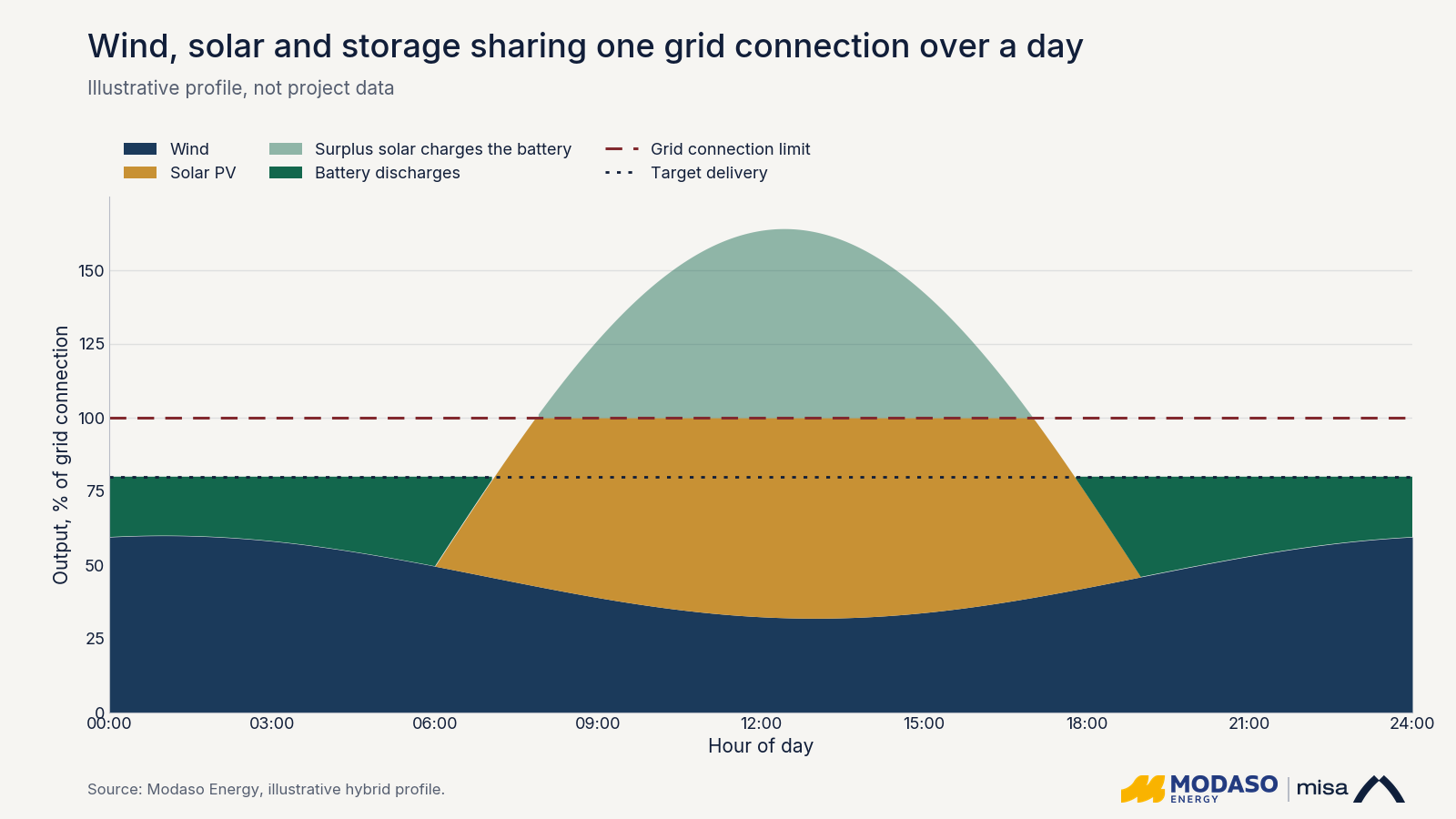
Wind is often strongest at night and solar at midday. A battery stores surplus solar above the grid limit and releases it when output would fall below the delivery target. Illustrative profile.
Does every megawatt of wind, solar and storage need to earn its place?
Wind, solar PV and battery storage are not a shopping list. Each should have a job in the economics.
Storage is now cheap enough to design in from the start. Battery costs fell by more than 90% in less than 15 years, one of the fastest declines seen in any clean energy technology (IEA, April 2024). Cheaper batteries make sizing more important, because it is now easy to buy more storage than a project needs.
A battery’s value is not its capacity alone. It depends on when it charges, when it discharges, and what it protects the project against. A fixed timetable can make storage look uneconomic because it does not respond to the commercial opportunity in each hour.
The right approach is to compare the base case with alternative configurations against the same hourly conditions. Some projects will not justify more equipment. Others will show a combination that changes the financing decision. Both are useful answers before capital is committed.
How do grid constraints shape African energy investment?
In many markets, the grid connection is the scarcest input. Hybrid power solutions can’t solve grid challenges, but they can be designed to be as efficient as possible considering these constraints.
A hybrid design treats the connection as the fixed point and sizes everything else around it. The Guruve-Mazowe Hybrid Energy Project in Zimbabwe, which MISA Group’s Modaso Energy is developing with Zimbabwean partner Tatanga Energy, began as a wind-only scheme. Modaso redesigned it as 128MW of wind, 100MWac of solar PV and a 50MW/100MWh battery behind a single 100MW grid connection. (Read more about the project in the news here.)
The number that drove the design was the 100MW connection, and the morning and evening hours when Zimbabwe’s demand peaks. The result is an average grid capacity factor above 65%, with the final configuration still under optimisation, and around 40% more energy from the same connection. Output also does not depend on rainfall or the water level at Kariba.
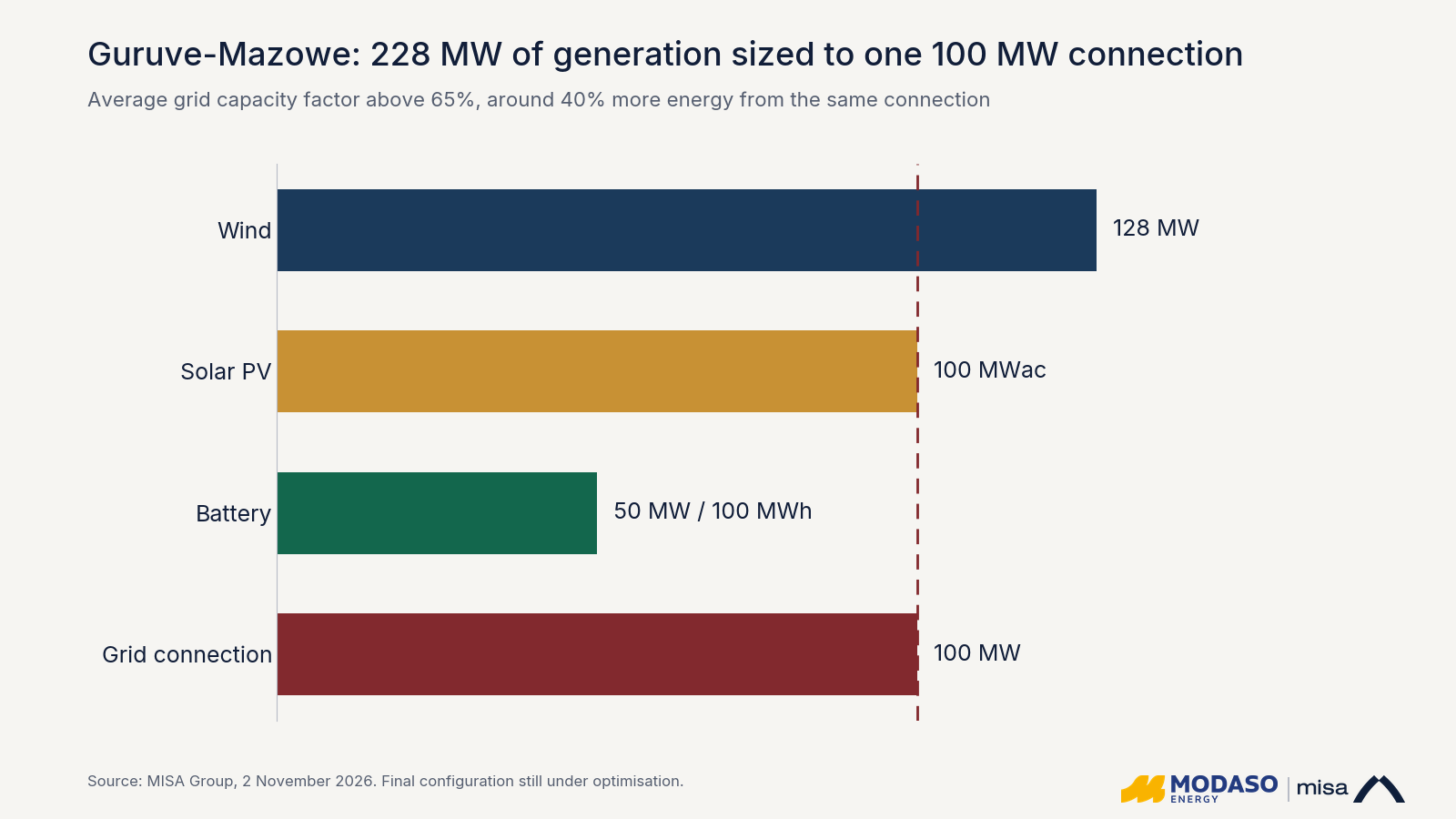
Guruve-Mazowe combines 128MW of wind, 100MWac of solar PV and a 50MW/100MWh battery behind one 100MW grid connection. Source: MISA Group, November 2026.
What makes renewable energy in Africa bankable for an investment committee?
An investment committee does not need an abstract technical optimum. It needs a recommendation it can examine: this is the configuration, this is why it creates value, and these are the assumptions that need validating.
That means treating resource, grid, offtake and dispatch as one decision rather than four separate studies. It also gives the developer a stronger conversation with the buyer, because it becomes possible to explain the trade-off between a firmer delivery profile and its price.
Lenders read the same evidence. A delivery profile that the system operator can plan around, tested hour by hour, is easier to finance than an annual yield figure, however large.
Where do Modaso Energy and MISA Group fit?
Modaso Energy is MISA Group’s hybrid renewable energy company. Modaso develops wind, solar and battery projects in Africa at industrial scale, with a renewable energy pipeline of more than 1GW targeted across Africa. Modaso’s in-house optimisation can reduce the battery capacity a project needs by up to 60% (Modaso Energy).
Modaso also holds a stake in Converge Hybrid, which enables accurate modelling for up to 30 years of wind, solar, storage, grid constraints and offtaker requirements before capital is committed. The two businesses work on different parts of the same problem: making hybrid renewable power useful to the buyer and financeable for the project.
MISA Group’s approach starts from the view that Africa is not under-resourced but under-invested. The group backs operators with deep local knowledge and holds for the long term, with no fund clock forcing an exit. That patience suits hybrid development, where finding the right configuration takes time and testing.
The question for a developer or investor is not how many megawatts a project contains. It is whether the design has been tested against the hours that create value.
Related reading
- Is African energy investment a choice between solar and oil?
- MISA Group leads development of Zimbabwe’s first utility-scale wind farm, a USD 300-million hybrid power project
- Why does population density matter for African energy investment?
"An investment committee does not need an abstract technical optimum. It needs a recommendation it can examine: this is the configuration, this is why it creates value, and these are the assumptions that need validating."
Charles Haworth
Co-founder and COO/CTO, Modaso Energy, part of MISA Group
Frequently asked questions about hybrid renewable energy in Africa
What is a hybrid renewable energy project?
A hybrid renewable energy project combines two or more generation sources, usually wind and solar PV, with battery storage at one site and behind one grid connection. Because wind and solar often peak at different times of day, and the battery can move energy between hours, a hybrid can deliver a steadier and more predictable supply than either source alone from the same grid capacity.
Why does a hybrid project need to be modelled hour by hour?
Revenue depends on when power is delivered, not on annual output. Offtake contracts, grid limits and delivery commitments all vary by hour. An annual model averages these away, so it can hide a configuration that misses the valuable hours or undervalues a site that meets them. Hourly modelling tests wind, solar, storage, and grid connection against the conditions the project will face.
Does a bigger battery make a hybrid project more bankable?
Not on its own. A battery adds value only when it charges and discharges at the right times and protects the project against a real commercial risk, such as a shortfall in an expensive hour. Oversizing adds cost without adding revenue. Modaso Energy’s in-house optimisation can reduce the battery capacity a project needs by up to 60%.
How do grid constraints affect renewable energy investment in Africa?
Where connection capacity is scarce, the grid connection becomes the fixed point of the design. In South Africa, the grid operator found no connection capacity left in the Eastern and Western Cape, then opened 1,580 MW more for wind farms that accept up to 4% curtailment. Hybrid projects respond by sharing one connection between several sources, so it carries more energy across the day.
What should investors ask before backing a hybrid renewable project in Africa?
Ask which hours the buyer values and why, what the delivery commitment is, and what a shortfall costs. Ask how the configuration was compared with alternatives under the same hourly conditions, and which assumptions still need validating. A strong developer can show why each element of wind, solar and storage earns its place in the economics.
Charles Haworth is Co-founder and COO/CTO of Modaso Energy, MISA Group’s hybrid renewable energy company. He has more than 18 years’ global experience in renewable energy, technology leadership and strategic operations. As COO and CFO of CWP Global, he oversaw a portfolio spanning five continents. Prior to that Charles spent 16 years at GE, including as Global Head of Commercial Operations, Offshore Wind. He holds a PhD in Physics from Imperial College London.
Posted in Articles